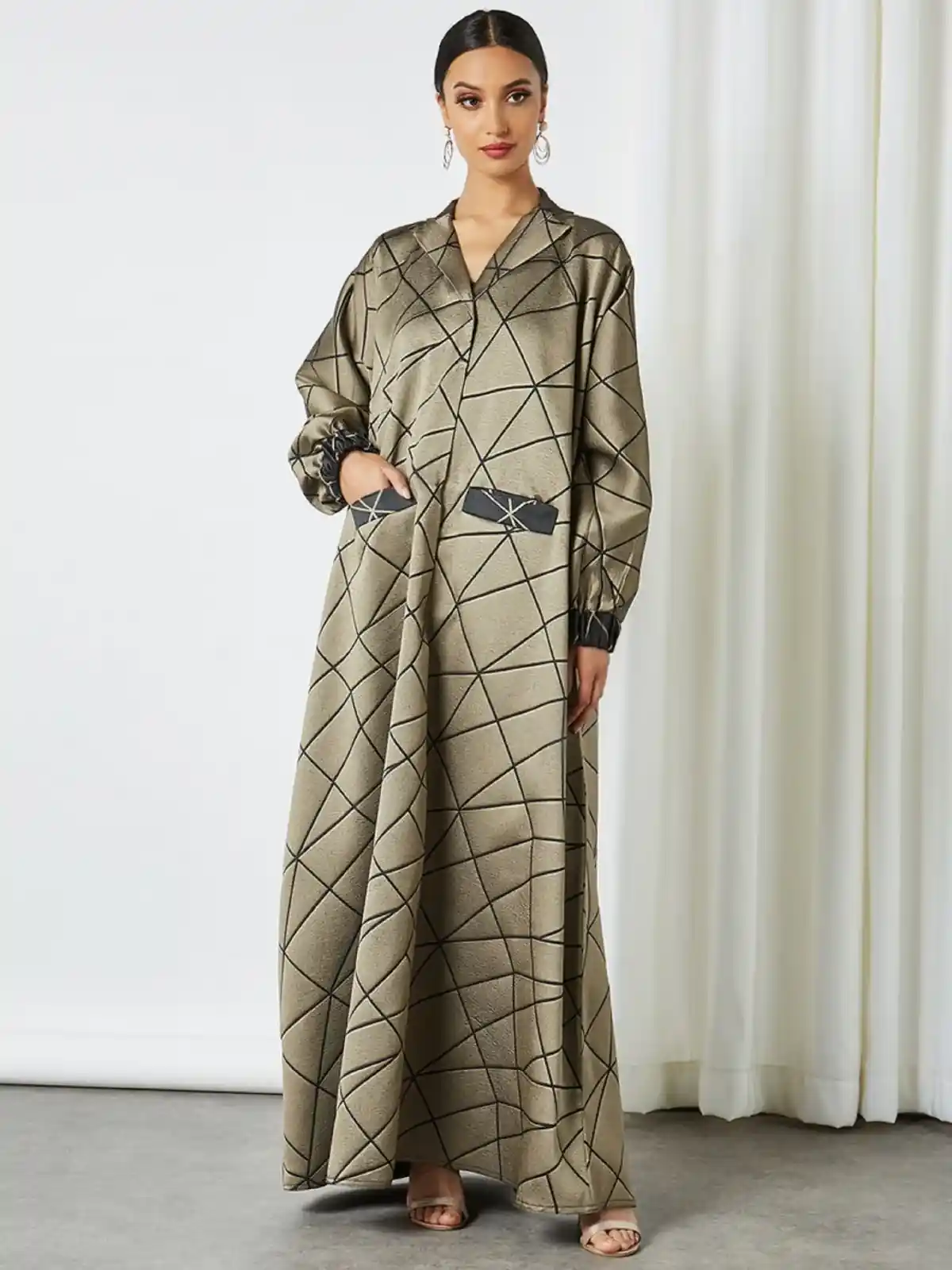
A closed-front column of clothpage one
Abayas
Open or closed, in a crepe that falls straight
Two abayas, one cloth. The open abaya hangs from the shoulder and closes with its own belt; the closed abaya fastens behind a placket with press studs. Both come in five lengths and two widths.
Open front or closed front
The open abaya is the more relaxed of the two. It sits on the shoulder like a long coat, the two front edges falling parallel to the hem, and it is meant to be worn over something: a dress, a long skirt and top, or wide trousers. The matching belt is cut from the same crepe and passes through two thread loops at the waist, so you can wear it tied, loosely knotted at the back, or not at all.
The closed abaya is cut as a single column. Its front fastens with six press studs hidden behind a narrow placket, so when it is done up nothing breaks the line from neck to hem. It can be worn on its own over a slip or light layers, and it pulls straight over the head without fuss once the top two studs are open.
If you are choosing your first piece, think about how you dress underneath. People who like to show a colour or a pattern beneath tend to reach for the open front; people who prefer one calm surface reach for the closed.
Open abaya, crepe — £68 · Closed abaya, crepe — £74
page two
The cloth
Crepe weight and drape
Our abaya crepe is a matte, nida-style weave of medium weight. It has enough body to hang straight from the shoulder without clinging at the hip, and enough give to move when you walk. It is opaque in daylight in every colour we stock, it does not crease badly in a suitcase, and it recovers on a hanger overnight.
Drape is the reason we chose it. A lighter crepe flutters and shows the shape beneath; a heavier one stands away from the body and feels warm by the afternoon. This weight sits between the two: it falls in long, soft vertical folds and swings a little when you turn, then settles again.
Sleeve styles
Both abayas share one sleeve: a straight sleeve cut slightly wider than the arm, finished with a turned cuff that is deep enough to fold back once if you prefer a shorter sleeve while cooking or writing. The open abaya has a softer, dropped shoulder; the closed abaya has a set-in shoulder so the column stays narrow.
There is no elastic at the wrist and no flared bell sleeve. Both of those are common, and both were left out because they catch on bags and doors.
Colours
Black, plum, taupe and deep olive, in both styles. Each colour is dyed in the same lot for the whole run of lengths, so a belt and its abaya always match.
page three
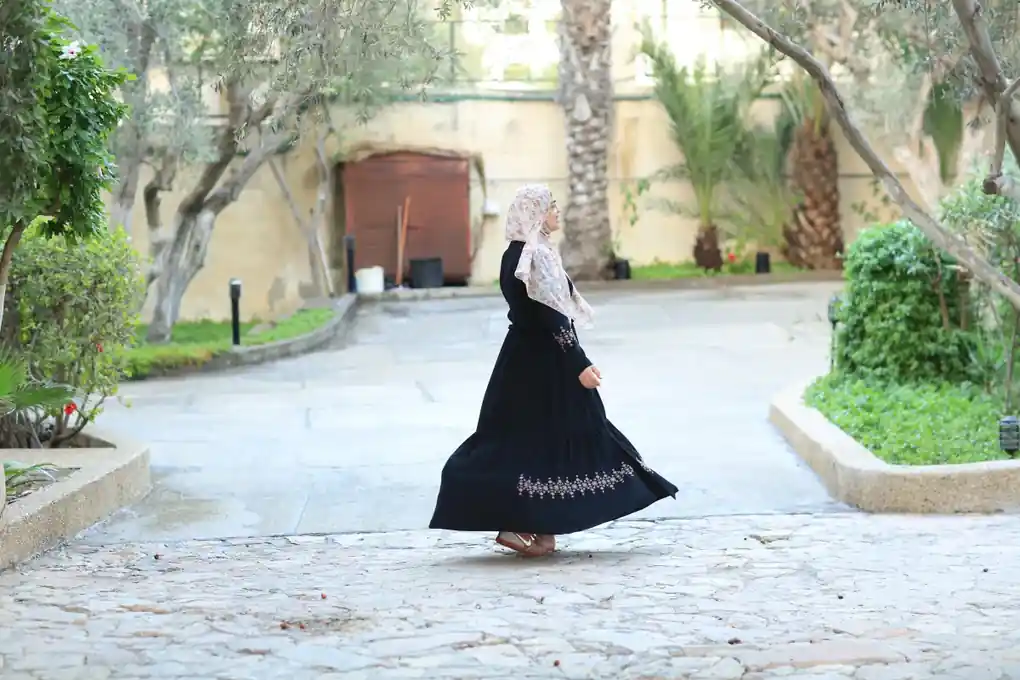
The hem lifts when you turnpage four
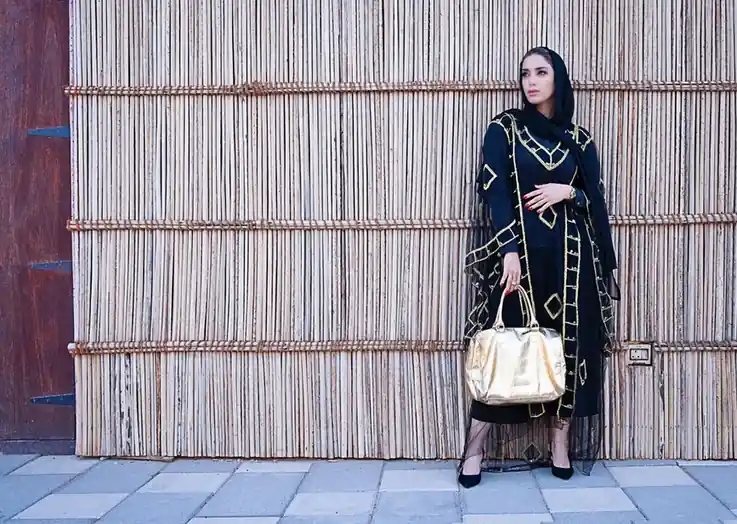
Length is measured shoulder to hempage five
Length per size
Five lengths, two widths
Abaya lengths are measured from the highest point of the shoulder, beside the neck, straight down to the hem. The height guide is a starting point for wearing with flat shoes; add one length if you wear heels most days.
| Length | In centimetres | Suits a height of |
|---|---|---|
| 52 in | 132 cm | about 150–155 cm |
| 54 in | 137 cm | about 156–160 cm |
| 56 in | 142 cm | about 161–165 cm |
| 58 in | 147 cm | about 166–170 cm |
| 60 in | 152 cm | about 171–176 cm |
Each length comes in a Regular width, which fits a bust up to 106 cm, and a Roomy width, which fits a bust up to 122 cm. The width changes the body and the sleeve; it does not change the length.
Prices
Care
- Wash at 30 degrees on a gentle cycle, inside out, with dark colours.
- Do not tumble dry. Hang straight from the shoulders while damp and the folds fall out.
- Press on a low heat with a cloth between iron and crepe; a hot iron leaves a shine.
- Keep the belt with the abaya when washing so the colour stays matched.
page six